Books

She prepared a face to meet the faces that she met

“She found it difficult, this thing of being alone, awaiting the arrival of a group. She prepared a face—as her favorite poet had it—to meet the faces that she met, and it was a procedure that required time and forewarning to function properly. In fact, when she was not in company it didn’t seem to her that she had a face at all… And yet in college, she was famed for being opinionated, a ‘personality’—the truth was she didn’t take these public passions home, or even out of the room, in any serious way. She didn’t feel she had any real opinions, or at least not in the way other people seemed to have them. Once the class was finished she saw at once how she might have argued the thing just as viciously and successfully the other way round; defended Flaubert over Foucault; rescued Austen from insult instead of Adorno. Was anyone ever genuinely attached to anything? She had no idea.”

—Zadie Smith, On Beauty

The happiness that attends disaster

“Emotions, in my experience, aren’t covered by single words. I don’t believe in ‘sadness,’ ‘joy,’ or ‘regret.’ Maybe the best proof that the language is patriarchal is that it oversimplifies feeling. I’d like to have at my disposal complicated hybrid emotions, Germanic train-car constructions like, say, ‘the happiness that attends disaster.’ Or: ‘the disappointment of sleeping with one’s fantasy.’ I’d like to show how ‘intimations of mortality brought on by aging family members’ connects with ‘the hatred of mirrors that begins in middle age.’ I’d like to have a word for ‘the sadness inspired by failing restaurants’ as well as for ‘the excitement of getting a room with a minibar.'”

—Jeffrey Eugenides, Middlesex

Where the cottonwoods grow

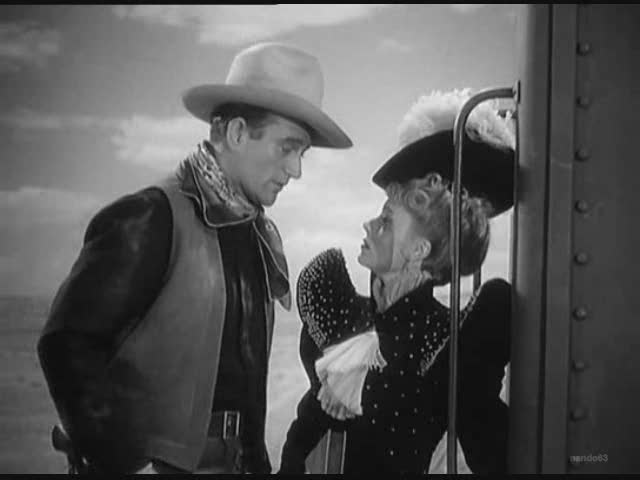
… and it was there, that summer of 1943 while the hot wind blew outside, that I first saw John Wayne. Saw the walk, heard the voice. Heard him tell the girl in a picture called War of the Wildcats that he would build her a house, ‘at the bend in the river where the cottonwoods grow.’ As it happened I did not grow up to be the kind of woman who is the heroine in a Western, and although the men I have known have had many virtues and have taken me to live in many places I have come to love, they have never been John Wayne, and they have never taken me to that bend in the river where the cottonwoods grow. Deep in that part of my heart where the artificial rain forever falls, that is still the line I wait to hear.”

—Joan Didion, “John Wayne: A Love Song” in Slouching Towards Bethlehem

On “how to be a woman”

I’m in the middle of a self-prescribed novel-devouring time in my life, with a hefty stack of books on my bedside table, their spines fresh and (mostly) un-bent (thanks Amazon for cheap used books that are ‘Like New’!). The thinking goes that somewhere between E.M. Forster and Joan Didion and War and Peace (which I’m saving for winter, to be read by a roaring fire with a mug of hot tea), I’ll come to some kind of slow, deeply-felt understanding of truth and beauty and writing and living. Omm.

I’m eight books in now, and I woke up the other day needing something different. So I started into the one non-fiction tome I had on my list: How to Be a Woman by Caitlin Moran. (Thanks to Phoebe & Catherine for the recommendation!)

Maybe I’m at a vulnerable place in my life, but man, this book spoke to me. Or rather, it made me laugh, which is arguably even better. It’s the grown-up version of the Angus, Thongs & Full-Frontal Snogging series (funny, silly books for and about British teenage girls), and it’s also a flat-out feminist manifesto for our time. Everyone should read it. Here is the most important passage:

“But of course, you might be asking yourself, ‘Am I a feminist? I might not be. I don’t know! I still don’t know what it is! I’m too knackered and confused to work it out. That curtain rod really still isn’t up! I don’t have time to work out if I am a women’s libber! There seems to be a lot to it. WHAT DOES IT MEAN?’

I understand.

So here is the quick way of working out if you’re a feminist. Put your hand in your underpants.

a. Do you have a vagina? and

b. Do you want to be in charge of it?

If you said ‘yes’ to both, then congratulations! You’re a feminist.

If you answered ‘no’ to the first question, try this: (a) Do you know someone who has a vagina? and (b) Do you want her to be in charge of it? If you said “yes” to both, then congratulations, you’re a feminist too! Now, back to Moran:

Because we need to reclaim the word ‘feminism.’ We need the word ‘feminism’ back real bad. When statistics come in saying that only 29 percent of American women would describe themselves as feminist—and only 42 percent of British women—I used to think, What do you think feminism IS , ladies? What part of ‘liberation for woman’ is not for you? Is it freedom to vote? The right not to be owned by the man you marry? The campaign for equal pay? ‘Vogue,’ by Madonna? Jeans? Did all that good shit GET ON YOUR NERVES? Or were you just DRUNK AT THE TIME OF SURVEY?”

—Caitlin Moran, How to Be a Woman

I spent a good deal of my senior year in college talking about feminism with my peers—analyzing the debate around it, trying to pinpoint when and how it came to be problematic, discussing if it was even relevant anymore, deciding how to “fix” it so it would “work” for more people. There were Women’s, Gender, and Sexuality Studies seminars. There were speakers and events about Shulamith Firestone and Sheryl Sandberg and sex.

So in the midst of this muddle, it’s nice to have Moran spell it out so plainly. This part of the debate is just not worth having.

The debate that is worth having is the one about sexism and equal treatment. I’m lucky: to my knowledge, I have yet to be discriminated against in any noticeable way for being a woman. (Aside from online commenters dissing my photo attached to a story I wrote, but ça va, that’s the Wild West of the interwebs for you and a whole other can of worms.) I have run in circles full of strong, leading women and equally talented, conscientious men. I’m young and admittedly can’t really see a glass ceiling for myself. Which doesn’t, obviously, mean it’s not there. That’s the point: you can’t see it.

So as many of my friends (and, eventually, me too) strike out into larger circles with more complicated social dynamics, I hope that all of us—men and women alike—don’t forget to keep one hand raised, checking for that invisible glass, making sure that when we feel it coming down to meet us we push back. Feminism isn’t scary: it’s just that simple act of pushing back, of taking a stance, of holding our ground with chin up. I think that is how to be a woman.
One month later; or, seeking nirvana

“…So you’re going to Yale. I used to want to go to Yale myself, once. Only I had to go where I could. I guess there is a time in the life of every young American of the class that wants to go to college or accepts the inevitability of education, when he wants to go to Yale or Harvard. Maybe that’s the value of Yale and Harvard to our American life: a kind of illusion of an intellectual nirvana that makes the ones that can’t go there work like hell where they do go, so as not to show up so poorly alongside of the ones that can go there. Still, ninety out of a hundred Yale and Harvard turn out but are reasonably bearable to live with, if they ain’t anything else. And that’s something to be said for any manufactory, I guess. But I’d like to have gone there…'”

—Faulkner, Mosquitoes

I went there.

When I graduated a month ago, everything happened at once: dark-blue gowns and cardboard packing boxes and parents. At night, there were clay pipes that we smoked and smashed on forbidden rooftops and lumps in the throat that wouldn’t go away, even when we sang and laughed and danced. Most people left in a rush—on to the next. I lingered, because I purposefully have no “next”, not right now.

In Mosquitoes, Faulkner’s character Fairchild—a talented novelist with an inferiority complex springing from his incomplete education—happens into a conversation with a young well-to-do man, Josh, who’s headed to Yale. Josh doesn’t much care where he goes; it’s not as though there were a choice, or as though anything different could have happened to him (and besides, he’s mainly interested in getting into a senior society). Fairchild only wishes had had the chance to go to Yale, even if the college is ultimately, as he says, “a kind of illusion of an intellectual nirvana.” It’s a nice snapshot of two men, separated by the birthright of class and money and reasonable expectations, yet both buying into the splendid myth of academia. Mosquitoes was first published in 1927, but Fairchild’s comment resonates with just as much bite and relevance today as ever.

No matter. The illusion—the myth—worked all its glory on me. And I know from experience that my friends were much better than “reasonably bearable” to live with. Luck shipped us all off to New Haven, and luck brought to us great people there who we learned from and grew to know.

But that was all a month ago. I’m home now, on the other, brighter coast. My friends and acquaintances are scattered far off in other cities, cultures, lives. The education from here on out is one we make, not one we take. The illusion of nirvana has ended; the quest for the real thing now begins.


“But words…”

“‘But words brought into a happy conjunction produce something that lives, just as soil and climate and an acorn in happy conjunction will produce a tree. Words are like acorns, you know. Every one of ‘em won’t make a tree, but if you just have enough of ‘em, you’re bound to get a tree sooner or later.’” —William Faulkner, Mosquitoes