Give this song a chance!! I promise it will get stuck in your head in the best of ways. It’s folksier than the usual stuff, PLUS it has an extraordinarily catchy chorus. Go on, give it a listen!
Give this song a chance!! I promise it will get stuck in your head in the best of ways. It’s folksier than the usual stuff, PLUS it has an extraordinarily catchy chorus. Go on, give it a listen!
It’s been six months since I left the East Coast for sunny southern California.
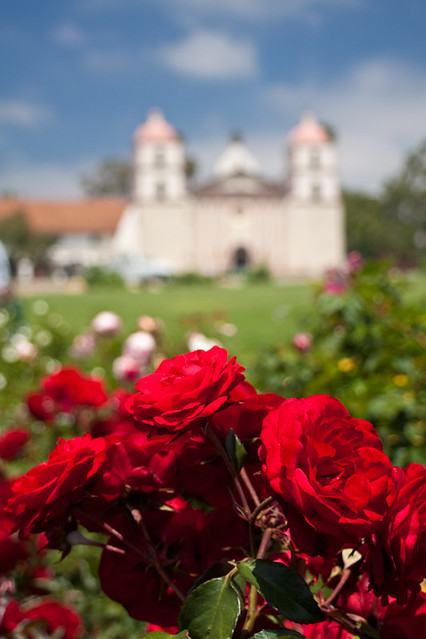
This evening I celebrated a childhood friend’s birthday with a picnic potluck in the public Santa Barbara rose garden. The roses, my namesake flower, were blooming in a big way. Behind us, the arcaded hall and facade of the old Mission, which dates back to 1820, glowed a buttery gold. My Catholic middle school held services there. As 8th graders in blue graduation robes, we posed for pictures out front after the Baccalaureate ceremony.
But there were no blue robes tonight. The sun set; the full moon rose; the candles were lit; and I met some of my generation’s version of hippies as we sprawled on picnic blankets in the gathering dew. They were creative and eclectic young people bedecked in unusual jewelry, flowing with talk of reiki healing and energy systems and the challenge of finding your way. Laugh all you want, but I love it.
That’s because I can relate to the challenge of finding your way. It’s been my primary life focus for the past half year. It’s driven me to seek solace and self-realization in endless yoga classes (and endless downward facing dogs); in long runs on the trails that crisscross my neighborhood’s citrus orchards and oak groves; in tall stacks of critically acclaimed novels; in hours spent mindlessly clicking through the wormhole of the Internet, jumping from food blogs to news sites to daunting job listings. It’s a challenge that has taught me the importance of talking things out with friends and family, and taking the time to ask for advice. It’s also taught me the importance of figuring things out for my self, and not letting the lives and opinions of others outweigh my own intuitions.
And the thing is, I’m pretty different in background and schooling from the alternative young people I hung out with tonight. But we all have this in common: We all worry about our futures. We all don’t know what America will look like for us anymore. We are open to so many different kinds of dreams.
Halfway through the night, in a lull in the conversation, my friend sidled up to me and asked: “What inspires you lately, Rais?” I was momentarily flustered. What inspires me? What a question! Who even asks that!
But it’s a good question. What does inspire each of us? Shouldn’t we be paying more attention to that on a daily basis?
After a minute of floundering for ideas, I started telling my friend about this NYT story on youth unemployment in Europe. The story is great, but it’s this multimedia feature that I found incredibly powerful, and that’s been haunting me ever since I read it. The Times introduces us to a slew of young people from southern and eastern Europe, all highly educated, all highly relatable, all trying hard to find their way. These were the kids I’d be friends with, had I been born in Milan or Dubrovnik. These are the young adults who I would have been. And they’re struggling: they see no future in their home countries; they see no future in the new ones they’ve adopted—for the time being—for the purpose of subsistence employment. They are a generation confused, depressed, uncertain of how to envision a long-term when the short-term is hard enough.
Laura, an Italian with two masters degrees, says:
“In general, the situation is quite depressing because young people don’t look at the future with hope. They see only a big black hole, and that’s it. It’s very scary. Sometimes I think it’s like the beginning of the last century, when people were forced to go to America because there was literally nothing here.”
Their quotes and stories haunt me, and, yes, inspire me. To do what? I don’t know. Maybe just to recognize the fairly universal experience of being a young person, of trying to figure out how to plan for a future you can’t fully envision. Of trying to decide what you want for yourself—and how you want to go about getting it. But unlike Laura, I am already in America; I am steeped in the privileges of health, family, citizenship, elite education—and rational hope. In this season of thanksgiving, cheesy as it is, their stories inspire me to appreciate my relative luck. American Millennials like me, despite a grim job market and grimmer economic prospects, are still fairly swimming in luck.
I’ve been lucky, over the past 6 months, to meet and interact with a motley collection of young people from outside of my college world—surf instructors, yoga addicts, artists, tutors, chefs, young professionals, students, waiters, organic farmers, tour guides—and it never ceases to amaze me how much we’re all the same: swaggering our way towards something, but (some secretly, others less so) second-guessing our decisions. It also amazes me how little it matters where we came from. College, with all of its pressures and concerns, seems pretty far away from where I sit.
I’m not sitting here for much longer, though. In fact, by next weekend, I’ll be in deep in the midst of college in all its Game weekend glory. I’ll be looking seriously at my future and career, and even considering making a more permanent life on that other, colder coast—or at least another, probably colder, city.
On one hand, I can’t wait.
On the other, I don’t think a 22-year-old (or anyone!) can ever be ready to plan for the future.
You just have to jump.
“…I always go to sea a sailor, because they make a point of paying me for my trouble, whereas they never pay passengers a single penny that I ever heard of. On the contrary, passengers themselves must pay. And there is all the difference in the world between paying and being paid. The act of paying is perhaps the most uncomfortable infliction that the two orchard thieves entailed upon us. But being paid—what will compare with it? The urbane activity with which a man receives money is really marvelous, considering that we so earnestly believe money to be the root of all earthly ills, and that on no account can a monied man enter heaven. Ah! how cheerfully we consign ourselves to perdition!”
—Herman Melville, Moby-Dick
Autumn nostalgia: “Chelsea Hotel No. 2” | Lana del Rey
“In Theravada Buddhism, the cause of all human suffering is identified, very succinctly, as craving. Tanha, it’s called, and it gives rise to the parasitic defilements of greed, hatred, and delusion. But the root of our problem, the cause of all human misery, is tanha: our insatiable craving for more. Economists have come to a similar judgment of the human condition, although they don’t levy any value judgments. To them, it simply is.”
—Peter Mountford, A Young Man’s Guide to Late Capitalism
Two albums. Two young women. Total opposites. And… I’m addicted to both.
 First up: Lorde. Royals is just the start. She’s from New Zealand, 16 (!), and writes her own (very poetic, very cool) lyrics. She’s the rebel-smart-girl who, I imagine, smokes cigarettes between classes but is really down with Salinger and gets As on her lit papers. She’ll drink an underage beer (or five) but gets home by her curfew. Then again, her parents are chill, so she probably doesn’t have a curfew. (Here is a great interview with her done by Interview mag, of course.)
Next up: Miley. Yeah, I know, I can’t help it: I’m into Bangerz. (Not every song, but… I am down with lots of it.) Miley is 20. She does not write her own lyrics; she gets top producers to do that for her. I don’t need to paint a picture of Miley’s life for you, because we’ve all been inundated with the details already. (But here’s her Rolling Stone cover story interview, just in case.)
They’re both Scorpios (although Miley’s on the cusp). Their music is big right now. They both go by pseudonyms. And they are both young women. Naturally, this means they are ripe for comparison: two ways to do fame, 2013-style, as a young female pop icon.

We all know that Miley is… just being Miley. She was famous before she was a personality; and now that she has the stage, she uses it to experiment with being a personality. At 20, she’s a seasoned star, posing nude for Terry Richardson; flaunting her body and sexuality on national TV; and making waves with her personal life, her style, and her ever-more-“rockstar” antics. OK Miley. You do you. And right now, Miley is—and/or wants everyone to think she is—a badass. Got it. Then comes the music: Bangerz is a mixed-bag album of collaborations with rappers, hip-hop producers, and “hood” (her words, not mine) influences. Some of it is catchy, some of it is crass, some of it is weak. The unifying thread throughout is Miley’s voice, which is satisfyingly straightforward: loud, clear, a little raspy, but under control. She’s no Beyonce in the vocal department, but she sings with strength.
Lorde, on the flip, came out of nowhere and remains—to a certain extent—an enigma. Which is how she likes it. Her break-out single Royals (and the rest of her debut album, Pure Heroine) is an ode to the punk nobodies; to the tough kids from the suburban block; to the small-town hipsters living a less-than-luxurious life on the outskirts of the city lights. In interviews, she reiterates this image and this background. She’s an outsider, reclusive but unmistakably cool, a quirky/regular teenage girl with a hard-won edge. So it goes with her album: it’s beat-and-voice heavy, uniformly slow, with haunting rhythms and choruses. Her soft, clear, slightly undulating voice wafts over synth beats. It’s hard to tell if she’s singing or speaking; no matter, the words lilt. And you pay attention to what she says.
(Note: I could write a whole post just comparing the videos from “Royals” and “We Can’t Stop”… There’s just TOO MUCH to #unpack and #decode, SO MUCH juicy cultural #appropriation and #representation, and endless amazing parallels…)
Miley’s face and body are everywhere. There’s barely an inch of her flesh that we haven’t seen. She’s out and about in LA, at parties, walking her dog; and the paparazzi snaps crop up copiously. She’s also a big social media sharer. Cleaned-up at a red carpet event or post-party makeup-streaked, the barrage of images streams endlessly. The only way for Miley to make a point with her personal brand, to get noticed against the background noise of her daily photographed life, is to be bolder, crazier, stupider: that always catches the public eye. Miley knows that, like any good kid of the reality-TV age. So she owns it all. YOLO is apparently her life motto. All publicity is good publicity—the bigger, the better.

Lorde initially released only one photo of herself, a classical chiaroscuro portrait (see above). Since then we’ve gotten a little more; but it’s a carefully curated selection. Unsmiling, heavy-lidded, never too candid, Lorde’s image is one that she continues to fully control and art-direct, in the way that only a true teenage Millennial can intuitively art-direct her own fledgling brand. In the same way that she feminized the masculine “Lord” to make her stage name by adding the “e” on the end and thereby playing on traditional precepts of royalty and power, so too has she co-opted the visual language of wealth, luxury, and celebrity in her pictures. There’s lots of dark lipstick, black winged eyeliner, flowing hair, gilded chain jewelry. Girl knows exactly what she’s doing. Her restraint speaks volumes about her vision—for herself and for her music. (She reminds me, actually, of early Lana del Rey, who chose a character for herself and created the mystery and sound to surround it. But where Lana thrived on 20th-century Americana and pin-up nostalgia, Lorde looks forward to a kind of ironically-rich post-economic-collapse aesthetic.)
(Now’s a good time for you to click over to my favorite Lorde song, The Love Club.)
And here’s the thing about Lorde: she’s 16, clearly beautiful, a pop star on the rise… and has, thus far, completely avoided the sexualization pitfall that inevitably makes (and, usually, breaks) all of the female pop stars… ever. (Think Madonna, Britney, Rihanna, Selena Gomez, Katy Perry, obviously Miley—all started young, all captured that lusted-after fame through the use of their own burgeoning sexualities, all had to figure out ways to deal with the ensuing objectification.) Instead, Lorde embraces the battles of youth, idealism, change, and growth. Am I being hyperbolic? Sure. She has a love song on her album. But it’s a GREAT love song, and it isn’t about her body.
Compare to Miley, who has gone above and beyond the classic call of female pop star sexuality, provoking strong reactions to her decisions in the feminist spectrum—is she inviting objectification or sidestepping it through appropriation? What to think of “Wrecking Ball,” which is a really great, raw, emotional song… but is accompanied by her most sexually-charged video yet? How DOES one interpret the licking of a sledgehammer in the context of the song? Is her Bangerz song “FU” emancipated or retreading old territory? etc.
(And you should listen to FU because why not?)
So: two young women. Today’s new pop princesses. Fame for both; Lorde’s is on the way up—and Miley’s is guaranteed for as long as she lives (if Lindsay Lohan is any indication).
And, for both, a definite rebellion against the rules of being a pretty-faced female singer. Miley’s rebellion against the script is to act out, to continually shock. Lorde’s is to reign everything in—to keep her clothes, her words, and her concept clean of the trashy side of pop, of the cheapening male gaze.
The cool thing about both cases (and one area where I have to give Miley credit, and applaud Lorde) is the self-awareness with which both artists approach their brands and images. They are not Britney, publicly melting down, hiding from the flashbulbs. They’re pop-culture-savvy. Their authority over their own sounds and looks makes them stand out from their peers.
I don’t know if you can call this “leaning in”—but at the very least, they’re looking everyone straight in the eye. That’s a good start.
” ‘My,’ she said. ‘We’re lucky that you found the place.’
‘We’re always lucky,’ I said and like a fool I did not knock on wood. There was wood everywhere in that apartment to knock on too.”
—Ernest Hemingway, A Moveable Feast

We see our schools—our institutions—as timeless, unchanging. That’s often why we go to places lauded for their centuries of accumulated wisdom and architecture, after all.
And we see the authority figures within them as guiding, enduring points of reference, fixed as stars.
When we leave, we encase a place in memory just as it was for us. When we return, we expect it to be the same. And for the most part it will hold true: each courtyard just as manicured and green, each stone pile of a building always catching the golden afternoon light. When the physical fixtures change, it can be jarring—but the spirit of the place stays intact. Over time our memories sift away to hold less of the physical space than the community that kept us transfixed within it.
 Students are temporary inhabitants of a school; that we know. We move in and out in clockwork motion, making the place ours, defining its culture, and just as ceaselessly moving on, leaving it all behind for another class, another club, another culture.
But what of the professors and leaders? The dining hall staff who prepared our food and groundskeepers who cleaned our stairwells? It may seem callous to say, but they become fixtures too; part of the school that does not grow or leave with us, but is there to stay (or so we feel). We interact and when it’s time we say goodbye. They are a part of our remembered landscape, as permanent in our recollections as carved stones.
So the loss of a figure—the irreversible loss—cuts deep. It is the loss of a person, but much more than that; it is the loss of the sacredness of the place. It is the loss of potential, and the loss of a past we thought could not change. It is the loss of the greeting we expected upon our return. It is the loss of a brilliance that made our time (and that of others) glow.
Dean Leslie Woodard was many things to many people: teacher, friend, mentor, role model, disciplinarian, advisor, cheerleader, instructor. And those people have a great deal more to say about her than I ever could. But for the selfish sake of wanting to remember her a little better, and wanting to understand a little more fully the role she played in my Yale, in my memory, I have a few things I want to set down for me, for her, for anyone.

I.
First days of freshman year. Fall semester registration. We’re called into the dining hall, 90 giddy kids, to sign our registration cards and make ourselves officially known as students. Dean Woodard introduces herself and proceeds to deliver a pep talk. She’s lithe and ageless, her voice surprisingly loud and—when she wants it to be—high-pitched. Every word is long, drawn out, inflected. I wish, now, that I had a transcript of what she said because it was much wiser than I realized then, of course. But the gist—at that meeting and at the start of every semester to come—was always the same: Welcome. Breathe deep. “Frolic.” Make friends. Enjoy this place as best you can. That first freshman speech gave us a license to be excited about being there. It gave us the freedom to have fun.
II.
Crying. It’s dumb, but there I am, crying, in her office. It’s nearing the end of freshman year and this is the first time I’ve been to see her for anything other than a perfunctory, upbeat schedule signing. It’s also the first time I’ve cried all year. One more first: for the first time in my life, I’m failing a class. (It would also be the last time.) This isn’t supposed to happen to me, I think. I met with the professor, I’ve had meetings with the TA. I’m trying, really truly trying. But I’m still failing. I have barely sat down in the chair across for her desk when I break down. “Pull yourself together,” she says. “You don’t need to cry.” She’s tough, Dean Woodard, and when I ask her what to do—which means, please tell me what to do, tell me how to fix this mess I’m somehow in—she is all business: withdraw from the class. Take summer session courses to get the required credits. When I complain that I already have summer plans, she doesn’t waver. If I can’t pass the class, then let’s move on to Plan B. There is no miracle solution.
I leave her office angry, frustrated. I’m used to advisors helping me out, not telling me there isn’t any help to be had. I don’t want to drop the class. I don’t want to change my summer plans.
So I decide against her advice. Instead, I decide that failing is not an option. I work harder, and ultimately I pass the class.
III.
First week of classes, spring semester, senior year—and I have the flu. I can already taste the bittersweet tang of nostalgia when I look around campus; maybe that’s partly why I can’t get out of bed. But I’m also running a fever and too weak to walk to the seminar in which I plan to write my senior essay. The professors want a note from my dean to excuse my absence. No note, no spot in the class, no senior essay. I email Dean Woodard, but she won’t give a note: it’s not a family emergency and I’m not in the hospital. Dean Woodard doesn’t provide excuses for things like being sick. She sticks to the letter of the rulebook, which says you suck it up. I’m panicking.
In Dean’s office, sitting in that same chair across her desk, I once again fall into self-pitying tears. Again: “You don’t need to cry.” She instructs me to tell the professors the truth: that dean’s excuses aren’t allowed for illness, but that they can call or email her directly if needed. Again, I leave frustrated, still panicking.
A few hours later, everything is smoothed over. The professors are fine with it. When I pass the message on to Dean Woodard, she shoots back an mail: “See. No tears needed! Feel better!”
IV.
Graduation weekend. I don’t want to leave. My plans are vague. The arrival of my family is overwhelming. Every thing I pack up is another goodbye to a life I’m not ready to give up. In the Calhoun courtyard, we graduating students sit in the undiluted sun surrounded by dressed-up family and friends, our navy robes sticky against sweaty skin. Best friends to my right, my left, in front and behind. Blue skies above. Green grass below. Red brick all around.
Dean Woodard’s speech is perfect. I wonder a little, as she talks, how it’s possible for her to get it so completely. She has always told us to “frolic” (her trademark word), to have fun. Now she’s telling us to be bold people, unafraid of letting go of this place and finding something new beyond. Her voice carries.
“But whether you are intimidated or joyous,” she says of the way we will choose to present ourselves post-Yale, “this moment of introduction represents an opportunity for all of you to keep what you want of your identity and shed what you do not. It is a time of tremendous power but perhaps that’s the scariest thing of all.”
“Marianne Williamson said and was subsequently quoted by Nelson Mandela, “Our deepest fear is not that we are inadequate. Our deepest fear is that we are powerful beyond measure. It is our light, not our darkness that frightens us most. We ask ourselves, ‘who am I to be brilliant, gorgeous, talented, famous?’ Who are you not to be? Playing it small does not serve the world. For as we are liberated from our own fear, so our presence liberates others.
“Powerful words, yes. But so very important, for this is your opportunity to introduce yourselves to the world entirely on your own terms, to be really, truly powerful, and to employ your presence for the empowerment others. So use the breadth of knowledge – both moral and intellectual — you have received at Yale and at Calhoun because by its virtue you are much better equipped than most and do not spend your energy trying to slip through life unnoticed. Let your mistakes be bold, your apologies sincere, remember that you and you alone are responsible for who you are and what you do. Resist the urge to tiptoe through the world. I’m not suggesting you wear only your heaviest shoes, your spikiest stilettos. Journey through life in comfortable shoes that allow you to walk when you wish, run when you wish. And when it is warm and lovely, go barefoot, feel the cool grass beneath the soles of your feet, take long, confident strides, and never ever forget to frolic!”
And when she reads out each of our names in her signature baseball-announcer voice, drawing out each syllable with an extra flourish, and hands over our diplomas and shakes our hands and sends us off, it’s hard not to think: here’s a woman of incredible confidence, of humor, of power.
V.
Right after graduation, I check my inbox to find an email from her, apologizing for mispronouncing my name during the diploma ceremony. I respond to tell her not to worry, and also to request a copy of her speech. She sends it back as an attachment almost immediately. “I hope you enjoy it!” she wrote. And: “I wish you all the best for the future! Keep in touch!!!”
I’m not sure if I ever did say goodbye in person. But I want to think that’s OK, in the end.
When I arrived at Yale, I thought Dean Woodard was supposed to be something of a safeguard: the person to protect me from my mistakes, to build me up when I was low, to help me navigate the rougher terrain of college. I had always, after all, gone to small schools.
But Dean saw it differently. We were to succeed on our own terms—not because of her assistance. When crises struck, her approach was tough but unerringly realistic. She didn’t fix things; she simply directed us toward the way we could fix them ourselves. It’s hard to overestimate how important that kind of an approach was for someone like me, who had always been privileged with wonderful oversight, parents and teachers and coaches who ensured that failure was not an option.
So when failure was an option, Dean made it clear that it was something I was to face myself. As with all things in life, I had a choice: to pick myself up and figure it out; or to let despondency, self-pity, or self-limitations take me down. It was the same thing whenever I went to her to look over my classes or discuss my extracurriculars. She never told me to do one thing over another. Instead, she questioned my decisions, and made me justify them. And as long as I could do that—as long as it was clear that I had a reason, that I had confidence, and that I was going to take responsibility for whatever I got myself into—she was happy to sign off on my plans. So I learned to do just that.
I often think that more than anything, my four years at Yale taught me humility. I saw what it was to be incapable of doing it all, to be less than the best, and to be overshadowed by peers who were willing to work harder, study longer, focus more.
But with the little bit of time and distance the past few months have afforded me, I’ve realized that Yale also taught me how to make choices for myself, and how to commit to a path of action. Or: how to have the confidence to direct my future, rather than let it simply happen. A great deal of that confidence came from figuring out that I could decide that—for instance—failure was not an option. It was something I built slowly throughout my time in college, and carry with me now. That self-knowledge came to me first from Dean, who was almost intimidating in her own self-assurance.
She forced me to act for myself.
I don’t know if there is a more meaningful lesson anyone can teach you. For that, I thank her, and am deeply grateful for the brief time I spent as one of her students. And for that, I am profoundly saddened by her death. Calhoun—Yale—has lost one of its finest instructors; not just in the classroom, but especially in the rather important life lessons of self-confidence, responsibility, and resilience.
I am sure that others who were better acquainted with her as a professor and as a friend will write of her academic brilliance, her quirky humor, and her vibrant spirit. These 2000-odd words on this blog in my tiny, nearly invisible corner of the Internet are but a small, self-reflective tribute. Still, all memories have value, I think, and the ones I have of her are strong.
When I go back to Yale next month, it will be different. Calhoun—my home at Yale—will not feel quite the same. I’ll know why. No buildings will have changed; the red brick walls and stone façades will be there, timeless as ever. The difference will be in the spirit of the place. The warmth of my college memories comes not from the cold stone halls of the libraries, but from the people whose words and actions shaped that home.
“…What makes your goodbyes so difficult,” Dean said in that same commencement speech, “is that this place and the people beside you and around you now possess for you the quality of punctum, they have pierced you, they are a part of you and you cannot, will not forget them, for one can never lose that which pierces be it a place, an ethos, or a person.”
Thank you, Dean Woodard, for all that you did and were and continue to do, even—especially—after you are gone.
“Yes, there is death in this business of whaling—a speechlessly quick chaotic bundling of man into Eternity. But what then? Methinks we have hugely mistaken this matter of Life and Death. Methinks that what they call my shadow here on earth is my true substance. Methinks that in looking at things spiritual, we are too much like oysters observing the sun through the water, and thinking that thick water the thinnest of air. Methinks my body is but the lees of my better being. In fact take my body who will, take it I say, it is not me.”
—Herman Melville, Moby-Dick
I finally caught up and finished watching Season 2 of The Newsroom, and at the end of it all I’m (still) feeling pretty half-hearted about Aaron Sorkin’s meta-foray into media drama. Like many critics and people involved in the news industry, it’s a show I love to hate but can’t help watching (and, against all odds, hoping for a third season). Here are my main problems:
(1) I can’t stand Alison Pill, her acting, the inconsistencies of her character, and the incompetence with which her character approaches bother professional and personal life.
(2) Similarly—and this is a flaw that has been widely remarked upon—the dichotomy between the gravity of the newsroom and the levity/ineptitude of social life across the board is stupid.
(2) The dialogue is almost always too fast, so we miss the good stuff.
(3) Speaking of which, even if the stuff is well-written, no one TALKS like that, Aaron Sorkin!! No one talks like that!
(4) The “Africa” thing, even though it was a while ago, still bugs me: a) the fact they always referred to the continent and not the country (because “Uganda” is too obscure for supposedly well-educated reporters?), b) the predictable nature of the plotline, c) the fact that Maggie got to go, when she had no expertise or background in the area, did not prove her competence or the critical nature of the story she was chasing, etc… international assignments are expensive, and therefore very hard to get and prestigious to be chosen for. Maggie can’t just “go to Africa.” This pushed all my buttons.
(5) This isn’t how the news is done.
(6) Operation Genoa? Really? Jerry Dantana? REALLY?

Lost in the desert where Sorkin left them.
So why do I watch?
(1) The lines are (usually) very smart and quippy.
(2) Sometimes it is nice to see the stuff the media messed up on the first time around be fixed retrospectively.
(3) Narcissism: I like watching shows that relate to my life, even if it’s a glamorized or inaccurate dramatization of a culture that I ascribe to.
I spent last summer working at a major news company. Although I was not a part of a daily show like News Night with Will McAvoy, I was part of a reporting and producing team that put together regular content for some of the most-watched news programming on television. My office environment was casual and chummy, but very professional: these people knew how to do their jobs. We approached each story with care and attention to detail. There was a lot of discussion with legal teams, a lot of scripting and transcribing, a lot of research and cold phone calls. We cruised Twitter and Facebook, blogs and social media — for sources and for tip-offs. (Unlike The Newsroom, we weren’t afraid of technology.) And more than anything I got really, really good at stalking people, finding phone numbers, and making cold calls. Because most of the time news does not fall into your lap. And most of the time you don’t have personal connections. So you make it work.
But those were on busy days with breaking news or investigations we needed to push through. The rest of the time I waited. And waited. And read the news. And waited.
Which is, of course, the biggest problem with The Newsroom: the sense that news is breaking all the time, that there’s a constant hype. News flash: news doesn’t break all the time. Big “breaking stories” are rare.
What changes, and what makes news compelling to watch, is that channels choose which stories they will follow and give air time. They select which narratives they will develop onscreen, as opposed to letting them languish and wither in the Internet ether. These narratives become news, even though they are almost never “new”. Because by the time 6:00pm rolls around, most of news-hungry America has already trawled through its own series of sites, gotten the alerts, heard the stuff that’s happening that day. Television’s role is increasingly not to tell us what’s going on, but rather to solidify the pre-eminence of certain storylines over others. To assign a hierarchy to the great mass of information and events that occurs all around the world each day.
Or at least, that’s how I see it. I can’t quite tell what Sorkin’s vision of evening television news is, though, and maybe that’s what bothers me most: is Sorkin envisioning News Night as the last great show in the canon of great news shows? As an arbiter of information hierarchies? Or as just another big never-ending whip-smart debate?
I don’t think Aaron Sorkin knows what he wants, unfortunately, because Aaron Sorkin is still suck in an era of television where the news shows actually mattered. Newsflash: news shows are not going to come back. The big thing today, across the media, are news brands—blogs, reporters, personalities, or channels that viewers trust and that can be accessed anywhere at any time; forward-thinking technology for 21st-century media consumers. In contrast, The Newsroom and everything about it takes place in the recent past—and so does Sorkin’s vision.
Then again, I never said I didn’t like a good bit of historical fiction!

The angst in this cast photo rivals that of the OC. Well done, News Night.
Over the course of Season 2, critics talked about how important it was for the team on The Newsroom to make the huge mistake that was Operation Genoa; it showed that even truth-tellers are fallible, and how they dealt with making professional mistakes humanized the characters. But the Season 2 finale, full of neatly-tied-up romantic plotlines and heroic men saving women from themselves (did you really need to lay it on quite that thick, Sorkin?) felt regressive, operatic, and cheesy.
If The Newsroom gets a third season, I’ll keep watching—because I’m curious, and I like some good guilty-pleasure liberal speechmaking (and the historical fiction, as I said). But as quality TV? Sorry Newsroom, but unlike your real-life versions, you suck.


 Raisa Bruner