Some smart people have written some very smart things on this latest Sheryl Sandberg / TeamWorkingLady / bossy-is-a-bad-word marketing fiasco, so I’ll let the links do the talking:
And my favorite: my friend Zara Kessler on Bloomberg View. Zara has coined the word “bossiful”, which we should ALL be using immediately. Goal for the weekend: use it in a sentence with 5 different people. Just spreading the bossy love.
Above is the star-studded #BanBossy campaign video, which has the right message but, ultimately, just the wrong hashtag. It goes back to the basic Lean In debate: do women adapt their attitudes and vocabularies to the already-existing culture, or do we attempt structural change? Sheryl says get with the program; the women linked to above say we’ve gotta change the paradigm. (Disclaimer: I agree with them.)
On a personal note, sure I was called bossy when I was younger—mostly by boys, but often by girls too. Sure it hurt—because it was somehow an insult; because it suggested I wasn’t “chill” enough, that I needed to just relax and care less about the class project, or the dance we were choreographing for a school show, or the extracurricular we were organizing. And yes, these were good lessons to learn about interpersonal communication and social interaction. You can’t go through life bossing people around indiscriminately. (Not that I was doing that, I hope…) Couch your commands in kindness; delegate with reason; lead with humility.
But bossy isn’t bad. I figured that one out soon enough. Bossy gets things done. Bossy doesn’t take no for an answer. Bossy knows that without her, things don’t happen.
Bossy is being a leader at the age where standing out from your peers is scary, uncomfortable, and not “popular” or “cool.”
And that’s really, really good. So, as those writers have articulated in the links above: don’t ban bossy. Celebrate what it truly means in a youth context. Encourage its positive affiliations for girls who are afraid to stand out. Don’t ban the word, because that makes it a stigma. Turn it into a compliment, because it means you’re speaking up.
As for me, right now I’m not the boss; far from it. But I damn well plan on being one. And being called “bossy” as a kid? There’s no shame in that now. In fact, in retrospect, it was definitely a compliment.
“But poetry (real poetry) is like that: you can sense it, you can feel it in the air, the way they say certain highly attuned animals (snakes, worms, rats, and some birds) can detect an earthquake.”
No, no, not the weather. Here in New York, it’s below freezing and I’m wearing three sweaters.
It’s all the rage though, and everybody’s doing it—everybody who’s anybody, that is. Or, if they aren’t doing it now, they plan to as soon as the timing’s right.
I’m not talking about spinning or zumba. Not Tinder, Grouper, or online dating (we can get to that later).
I’m talking about working at a tech start-up. (NOTE: This post is not a how-to guide for start-up success. If that’s your jam, go have fun at this blog instead.)
For a few months, I ran the media side of a small tech start-up called Mavrx. Mavrx provides critical image mapping and big-data analytics for agricultural operations. (Hit up our website for more info.) We were in Cape Town to work with South African vineyards and grape-growers during their growing season. While there, we tailored our tech product to best fit their needs. The next steps: expanding our market to other countries, other crops, and even other industries.
Not a bad substitute for a cubicle…
Now, I’m back in the Big Apple—about as different in culture (and temperature) from Cape Town as possible. As I inevitably meet new people here, the same questions crop up: Oh, you were at a tech start-up? What did you do? Did you like it?
As the media & communications guru for Mavrx (a self-proclaimed title, I admit), it was my job to run the public image of our fledgling company. I designed a website, put together press and sales and pitch materials, blogged, Tweeted, Instagrammed, and generally managed what I call “brand development.” I had dabbled in all of these things before, but… it’s different in a start-up. Each task required me to muster up a full measure independence, self-confidence, and initiative.
Here’s the thing about working in a small company with no set structure and no guidelines to follow: you make it all up yourself. You learn a hell of a lot. You mess up. And you figure out, slowly, what makes you tick in a work environment. For someone who’s played by the rules all her life, I often felt that I’d suddenly been thrown into the deep end. The good part? I learned to swim.
Tasting fresh grapes on the vines was a serious perk of the South Africa job.
I’ve always been worried about work-life balance; I’m not particularly skilled at doing anything in moderation. For me—and I think for many of us—it’s always all work or all play. Some of my internship experiences had left me thinking that a finite workday would be ideal; just clock out and sleep easy. But other internships reminded me how important it is to work towards the bigger picture—a place where, even at midnight on a Friday when your friends are texting you from the bar, you know you’re doing something meaningful.
And start-ups? No thanks, I used to think. It seemed to me the worst of two worlds: the 24-hour intensity of a job that never ends, matched with the questionable ethics of a get-rich-quick scheme. (No offense intended to those awesome people I know who have had the guts, wisdom, and self-confidence to be entrepreneurs from the start. I never said I was right about any of this.) Still, the appeal of the “tech” industry eluded me. I may be a nerd, I thought, but I’m no geek.
There’s a geek in all of us, though, and—as reporting has taught me all along—asking the right questions will make any subject, however seemingly mundane, totally fascinating. So even though I was clueless about NDVI imaging, precision agriculture, viticultural technology, and harvest planning, I asked questions in South Africa. This is what happens in a good start-up: the pieces begin to fall into place, and the vision becomes something worth working toward. It might even, if you’re lucky, come to consume you. Then the line between work and play is blurred, and you’re not trying to get rich quick or even get investors—you’re just trying to make something important happen, and you believe fundamentally in it.
From Cape Town to Brooklyn, I’ve been lucky to live on some very cool streets lately.
My first tech start-up chapter has closed—for now. Once again I’m not certain of the next step. I’m also not sure if I’m much closer to figuring out that work-life balance thing. But for the first time, it doesn’t matter and it doesn’t scare me. There are only two things I want: to work with people who make me work harder, and to believe in what I’m building.
Sure, some people will always want to clock out at 5:00pm. The secret, though, is that everything’s more fun when the clock’s always ticking. Deadlines will make your heart beat faster, looming consequences will keep you focused, and that adrenaline rush? Time may pass, but it’ll keep you young.
When I’ve traveled over the last few years, I’ve found it harder and harder to happily play the tourist. Instead, I want to be the local.* So I make-believe that I’m setting up a life in whatever city I’m in. I’ll choose a cafe to haunt, a grocery store to run through, a club to dance at, a group of friends to call my crew.
Still life: Saturday afternoon at my favorite cafe in Cape Town.
But there’s always the sense of impermanence. Whatever life I’m setting up is bound to fall away—next week, next month, whenever the plane carries me off into the blue. Then back to the “real” thing, back home, see ya never new city and new friends.
That’s the challenge about travel, I think. It’s a tantalizing reminder of all the lives we can—could—live. It invites us to consider the possibilities of an alternate path, but never lets us fully commit to the change. It’s a desperate tease.
After two weeks in Cape Town, I’m feeling this stretch more than ever. I have my cafe, I have my routine, I even have my new friends. I can see—so easily!—the life I could lead here; it’s a city to fall in love with. But it’s not mine. Anxious, I have to ask myself: what’s the point of travel if we can’t grow roots? I’m an earth sign; I need that stability, that grounding in place and time.
The answer, of course, is that it’s a learning process. The more I shake up my idea of home, the more I push myself to consider the alternatives (another piercing? backpacking through Thailand? embracing California?), the more I know about what I need from the place where I will set down those roots. And, maybe most importantly, the more I can strip away the illusions I have about myself. (No, I will never be the backpacking-through-Thailand type. No, I am not a surfer girl. And no, that piercing is definitely a bad idea. As a friend here reminded me, I am not “chill,” however much I might like to think that I am. And that’s totally OK.)
It’s incredible to have the opportunity to meet new people and go new places. But sometimes, the best part of all that newness is recognizing just how the old stuff—home—is also full of the power to shape us.
*For my anthro/cultures-of-travel friends: I will be investigating the “local” complex and why that’s problematic in future, don’t worry.
“I had already seen the end of fall come through boyhood, youth and young manhood, and in one place you could write about it better than in another. That was called transplanting yourself, I thought, and it could be as necessary with people as with other sorts of growing things.”
At their best, movies elevate the images of the lives we don’t lead into all-consuming, believable, magical art. At their worst, they fail to convince us that the lives we are watching unfold onscreen are worth our time, our attention, our money. At their best, they instill dreams—and nightmares. At their worst, they’re forgettable.
From that standpoint, American Hustle and The Wolf of Wall Street are two pretty good movies. I watched them on back-to-back nights, and the comparisons between the two cropped up unbidden. We’ve got blockbuster directors, high-wattage celebrity casts, and unlovable anti-hero main characters—all bound up in two twisted, demoralized takes on the classic American rags-to-riches storylines we know and love so well (thanks, Horatio Alger). Before you watch these movies, I recommend setting aside your moral compass. In the worlds of Hustle and Wolf, right and wrong don’t apply. The compass points to success and survival; don’t bother with north.
Wolf first. Leo diCaprio first. We’ve seen him evolve from Titanic‘s sensitive romantic to Romeo + Juliet‘s violent, sensitive romantic to Catch Me If You Can‘s confident impostor to The Aviator‘s over-confident visionary to The Great Gatsby‘s sensitive, romantic, over-confident impostor-visionary to… this. It’s the rawest of the Leos yet. The swagger—and there’s lots of it—is not fake, but instead bursts from an ego inflated by the crudest kind of successes. Jordan Belfort (real person, real story, real asshole) is a salesman, and that’s what Leo plays: the kind of salesman who has nothing beneath the pitch, not even an interior consciousness. His life is the pitch. And The Wolf of Wall Street, with its Leo voiceover narrating and explaining events as we see them onscreen, is the pitch.
Once we get that, we can let Scorsese do his work. What really happened doesn’t matter, because we’re getting the memory of it—the feeling of it. And what a feeling. Sex, drugs, gratuitous naked flesh, more drugs, more strippers, fancy cars, hot blondes, fancy clothes, expensive yachts, beautiful homes, public urination, violence, wads of cash, testosterone, bacchanalian parties, and the sheer, irascible, powerful force of GREED: Scorsese shoves this stuff in our faces with a reckless, dangerous enthusiasm. It’s glorious. It’s seductive. It’s despicable.
Up-by-his-bootstraps Jordan Belfort and his finance firm conned investors out of millions of dollars, lining their own pockets instead (a tactic explained early on by a pitch-perfect Matthew McConaughey as an innocent young Jordan’s first raunchy boss). In the movie’s telling, the motive is always just money. And behind the money is the art of the sale—of your business, of your shitty penny-stocks, of your self (and, inescapably, your soul). Scorsese doesn’t give us any likable characters. They’re all absolute shmucks. Instead, he wants you to drink up that world of unfettered conspicuous consumption; he wants you to get wasted on it, on the saturated colors and naked breasts and endless lines of coke. And once you do, you’re along for an aggressive 3-hour trip that doesn’t let up. (Luckily, this one doesn’t come with a hangover.)
Leo in his office element. Those baby blues!
The Wolf is also a story of addiction. Jordan is addicted to sex, drugs, and making money. It’s those addictions—particularly the last one—that drive him from nothing to something bigger than he can handle. He gets his true high when he’s selling himself to his staff, who worship him cultishly. Everything else fades away, and for a second we see the terrifying beauty of the self-made man who has bought into his own myth. He either will not or cannot see anything beyond it.
Scorsese doesn’t pass judgment. The shocking shallowness of The Wolf isn’t supposed to be a reprimand to American consumer culture; if anything, all the things that (dirty) money can buy are lovingly fetishized with that slick Hollywood lighting and Leo’s sexy voiceover. (That includes naked women in all objectified forms. From a feminist perspective, this movie is abominable. I’m trying to set that aside so I can critique it more objectively. Not sure if that’s a good thing, though.) There’s something both shiny and grotesque about the whole thing—the story, the way it’s filmed, the characters—and I still can’t decide if it’s revolting or appealing. Is hedonism so bad, after all? Hasn’t America always revered this kind of man? Hasn’t he always been our way in, our dream, and our addiction?
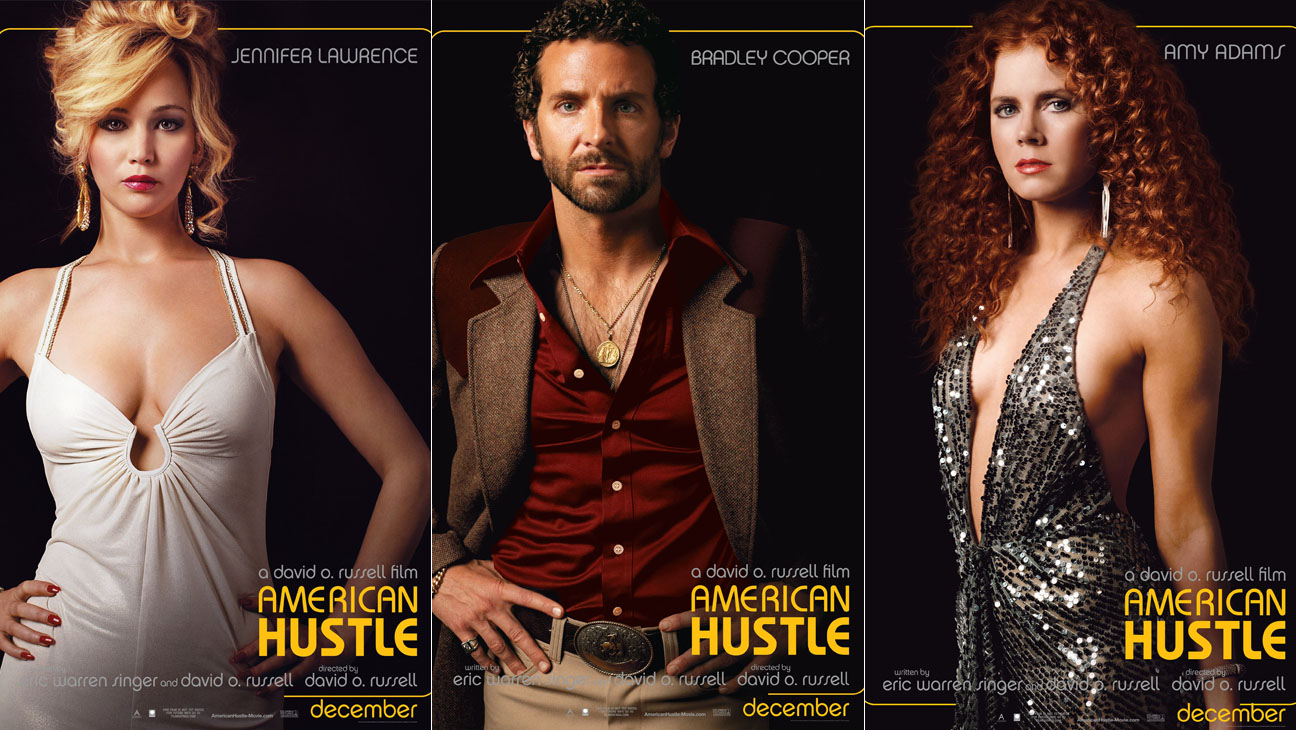
American Hustle is also about the art of the sale—in this case, the ability of a sadly de-Batman-ified Christian Bale and an oddly sexed-up/tits-out Amy Adams to sell fake loans. They get caught by an over-ambitious, hyperactive FBI agent (an energetic Bradley Cooper) and end up working a complex con involving a fake Arab sheikh, a half-dozen corrupt politicians, and Robert deNiro in an inspired cameo as a mob boss.
But Hustle is less about the work they do than the things they conceal about themselves, the human relationships they struggle with—and what drives each of them to get a little bit ahead. It’s a more nuanced movie than Wolf (thankfully); these guys all do have interior lives. It’s also much slower and sometimes angling towards dull. (I have to wonder if they dressed Amy Adams in free-boobing costumes slit down-to-there in every scene for character purposes… or more likely just to keep male viewers engaged.) Where Wolf never stops striving for more, more, more, the characters of Bale and Adams are content with just enough to be better than the rest… until Cooper wants more, more, more, and then they’re hustling for real. The Hustle here isn’t necessarily money: it’s staying one step ahead of the game, whether that’s in love or in career. It’s an addiction, one could say, to “getting over” the other guys (in Amy Adams’s words). The only one left out (at first) is Jennifer Lawrence, the spurned, airhead wife—but she gets in on the action in her own way, too. (She’s also, in my opinion, the movie’s hands-down highlight.)
Again, no heroes; no clear good-guy/bad-guy; no ethics separating those who succeed from those who fail. There’s a shady glamour in Adams & Bale’s small-time pre-FBI work. The movie is a love story to the low-rent hustle, to the small not-so-great things people do in order to lead almost-great lives. It’s only when they go big that things start to crumble; the love story is up, the romance begins to fray, there’s infidelity on a number of levels. But they pull it together, conning their way back into stability. Faking it until they make it. Classic.
Sweet costume design, though.
In Wolf, you root for Jordan Belfort not because you like him, but because you want to be at the crazy party he’s throwing with all that Leo charisma… and you believe in our American right to have that kind of party. In Hustle, you root for Bale not because you like him, but because you want to believe that for this one very flawed—but not irredeemable—regular guy, his story can have a happy ending… just like yours.
Oh, America, aren’t we predictable. The self-made man is always our favorite Hollywood flavor—served with a side of sexed-up women, naturally. They will sell this vulgar myth to us as art until the end of days, and like Jordan Belfort, we will never be sated. It’s bad, it’s morally reprehensible, I shouldn’t be supporting the film industry making this stuff… but as movies, they are pretty damn good.
For the sake of remembrances, please indulge me briefly.
Things I did in the second half of 2013(because the first half is too long ago to remember): turned 22; graduated from college; read 35 books for pleasure; re-taught myself to play the piano; spent a lot of hours on the road; fell in love with One Direction; tasted a lot of wine; started running; slept; snorkeled with giant sea turtles; finished all five seasons of Friday Night Lights; galloped on horseback in the Andes; backed up my files to Cloud storage; went on a solo road trip and loved it; flossed; organized my closet; read all 5 Song of Ice & Fire books (those are 1000+ pages each, y’all!) and re-read all 7 Harry Potters; became an Instagram pro; ate a lot of vegetables; spent a good deal of time with family; soul-searched and self-actualized; figured out the kind of person I might like to be—for now, at least.
Things I’m still working on for 2014: completing a yoga handstand; finishing Moby-Dick; going to sleep regularly at a reasonable hour; learning how to properly use Pinterest; deciding where January will take me; brushing up on my Portuguese; finding employment; cleaning my desk; blogging more often.
I’ll end this with a favorite quote.
“Philosophers like to point out that ‘place’ is as much within us as without us. You can demarcate a place on a map, pinpoint its latitude and longitude with global positioning satellites, and kick the very real dirt of its very real ground. But that’s inevitably going to be only half the story.The other half of the story comes from us, from the stories we tell about a place and our experience of it. As the philosopher Edward Casey writes, ‘Stripping away cultural or linguistic accretions, we shall never find a pure place lying underneath.’ All we shall find instead are ‘continuous and changing qualifications of particular places.’ When we travel, we fix a place’s meaning in our minds. It is in the eyes of a pilgrim that a holy site becomes holiest. And in being there, he affirms not only the place’s significance but also his own. Our physical place helps us better know our psychic place — our identity.“
—Andrew Blum, Tubes
Happy New Year y’all. Breathe deep, pop bottles, and play hard.
AND – most importantly – a big thank you to those of you who drop by this little smidgen of space on the interwebs & read what I have to say! You are golden.
The road will take you wherever you want it to go, you know?
“Words and emotions are simple currencies. If we inflate them, they lose their value, just like money. They begin to mean nothing. Use ‘beautiful’ to describe a sandwich and the word means nothing. Since the war, there is no more room for inflated language. Words and feelings are small now—clear and precise. Humble like dreams.”








 Raisa Bruner